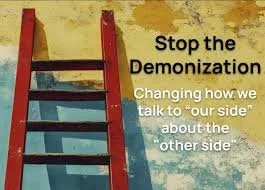
The Flip side of Democratic Empathy: Political Demonology
A Living Room Conversation
Monday, February 9 | 7:00 pm
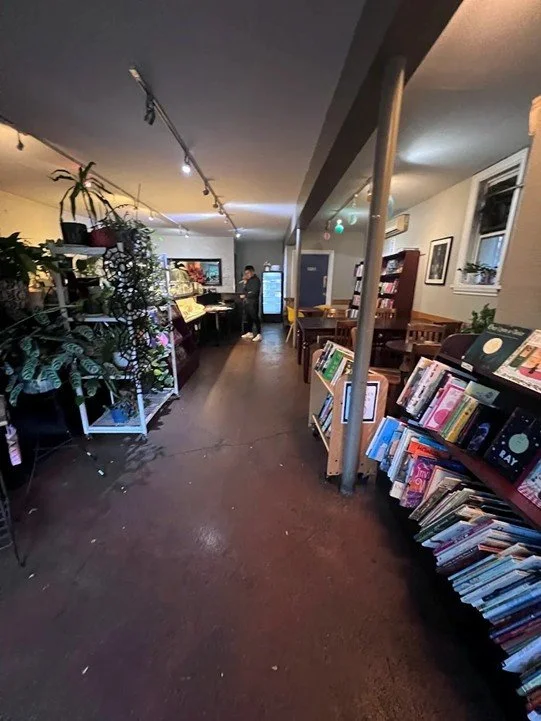
Bernie’s Café & Bookstore, 3966 24th Street (between Noe & Sanchez)
Monthly Living Room Conversations are small, facilitated discussions where everyone speaks andwe explore how to engage politically without losing our humanity.
Please RSVP to townsquaredemocracy@gmail.com
Hello Friends,
Another month, another daily barrage of actions confronting us with serious moral questions about thestate of our society. In the face of alarming news, we are taking public action at some times, and takingcare of our emotional sanity at other times.
This periodic self-reflection is not disengagement; it is strategic self-examination and repair. Talkingtogether helps us think more clearly and choose how we want to respond without losing our humanityor depriving others of theirs. This is the concept of "living room conversations". On that note, you areinvited to our next gathering:
Professor Austin Sarat has argued that empathy is a necessary tool for recovering the practice of democracy. We might go even further: empathy is a shield for our humanity. When we practice empathy, we grant other people a measure of humanity, even if we do not support their choices.
As we discussed at our January meeting, it is important that we see and reckon with the MAGA campaign to destroy empathy, as this effort goes hand in hand with efforts to deny any measure of humanity to anyone outside the narrow perimeter of their identity group. As we have been witnessing, like other fascist regimes, MAGA dehumanizes targeted groups in order to create Others on whom ills can be blamed, and whose destruction can therefore be justified as an act of “good vs. evil”.
This strategy has a name: “political demonology”. Like everything else about MAGA, political demonology is not new, and people have been studying it for a while now. We’ll talk about this phenomenon as practiced by MAGA through examples, to ground our understanding.We’ll also consider the secondary risks:
In our response, should we mirror this strategy by acting the same way toward those who deploy it, and further normalize this political practice?
Are we already doing that, in the way we talk about “those people” or "that person"?
If we are contributing to the normalization of a destructive strategy, is it worth the emotional satisfaction that can be found in partaking of this rhetoric?
Democratic politics require that we practice the art of living together in society. What can we do about “political demonology” that won’t just feed it?
To preserve the conversation feeling, we can include up to 20 people per meeting. Please RSVP totownsquaredemocracy@gmail.com to let us know you'll be join in
Reading Options
Up to 5 minutes each: quick overview Nabb Research Center Online Exhibits: Demonization Wikipedia: Demonizing the Enemy Wikipedia: Springfield Pet Eating HoaxDHS Press Release: Call to Stop Demonization
10-15 minutes to read: argument/report Demonizing Our Opponents: A Threat to Public Discourse (1996)'Politics of Demonization' Breeding Division and Fear (2017
20-30 minutes to read: academic study and analysis Political Concepts/A Political Lexicon: Demonization Political Theology Network: Demonology
Reading options
Up to 5 minutes each: quick overview
Nabb Research Center Online Exhibits: Demonization
Wikipedia: Demonizing the Enemy
Wikipedia: Springfield Pet Eating Hoax
DHS Press Release: Call to Stop Demonization
10-15 minutes to read: argument/report
Demonizing Our Opponents: A Threat to Public Discourse (1996)
'Politics of Demonization' Breeding Division and Fear (2017)
20-30 minutes to read: academic study and analysis